![[DEV] MN Catholic Conference](https://assets.nationbuilder.com/themes/65df773c6ffa600228371ffb/attachments/original/1709322834/logo.png?1709322834)
Stop Harms of Addictive Social Media for Kids
An Effort to Empower Parents and Protect Youth’s Experience Online
The problem
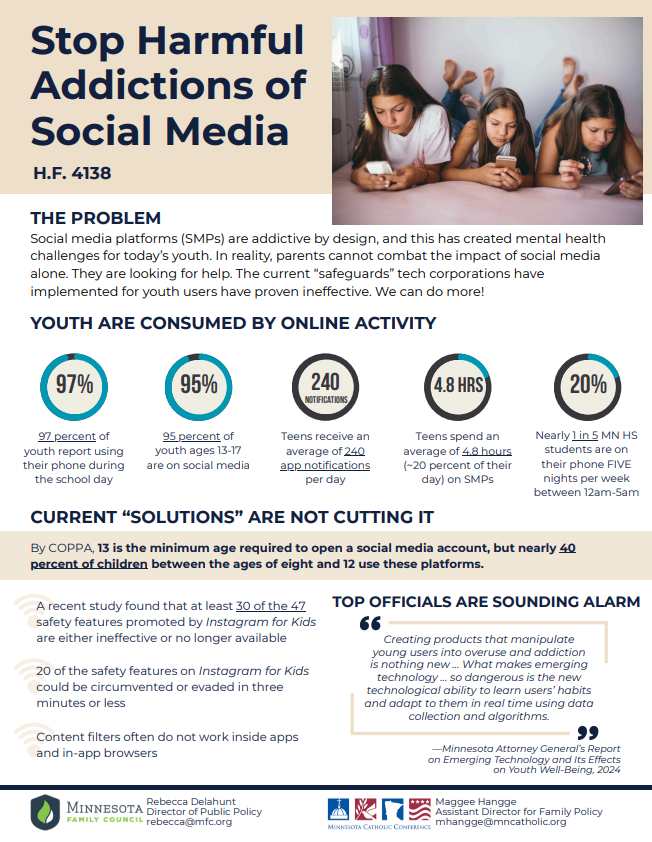
Youth are spending exorbitant amounts of time online, which has contributed to the rising rates of anxiety, depression, sleep disruption, self-harm, and social isolation among our children.
- 97 percent of youth report using their phone during the school day
- 95 percent of youth ages 13-17 are on social media
- Teens spend an average of 4.8 hours (~20 percent of their day) on social media
- Nearly 1 in 5 Minnesota High School students are on their phones five nights per week between 12 am and 5 am
Parents need help
Due to the fast-evolving nature of these platforms, parents are struggling to keep up with what their kids are doing online. Often, when a child participates in an activity, whether it is a field trip at school, a sports activity, or otherwise, a waiver or permission slip is signed by the parent. But when it comes to kids’ online presence, they can make accounts without their parents’ permission or awareness. This is not ok.
Plus, the current “safeguards” tech corporations have implemented for youth users have proven ineffective:
- A recent study found that at least 30 of the 47 safety features promoted by Instagram for Kids are either ineffective or no longer available
- 20 of the safety features on Instagram for Kids could be circumvented or evaded in three minutes or less
- The solution: put parents back in the driver's seat
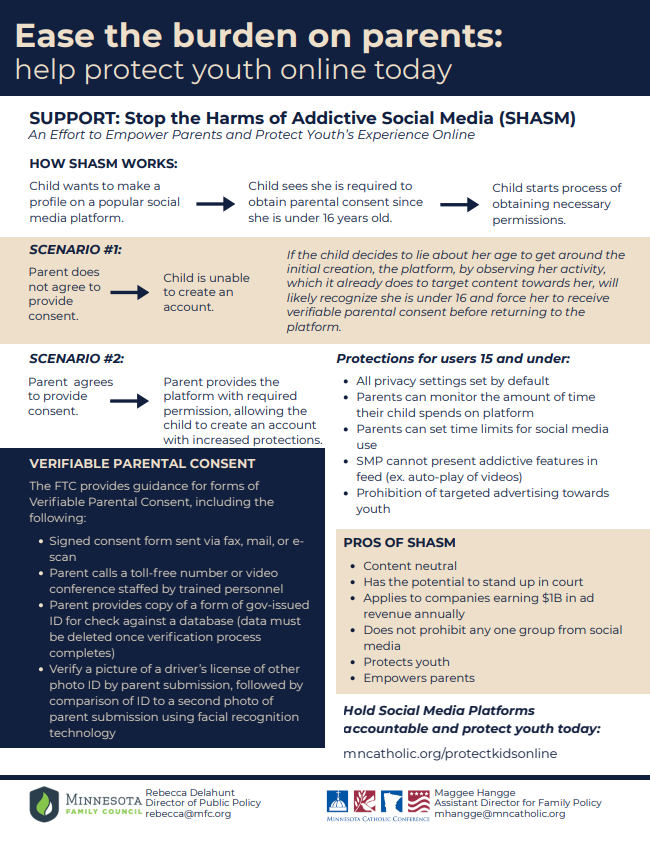
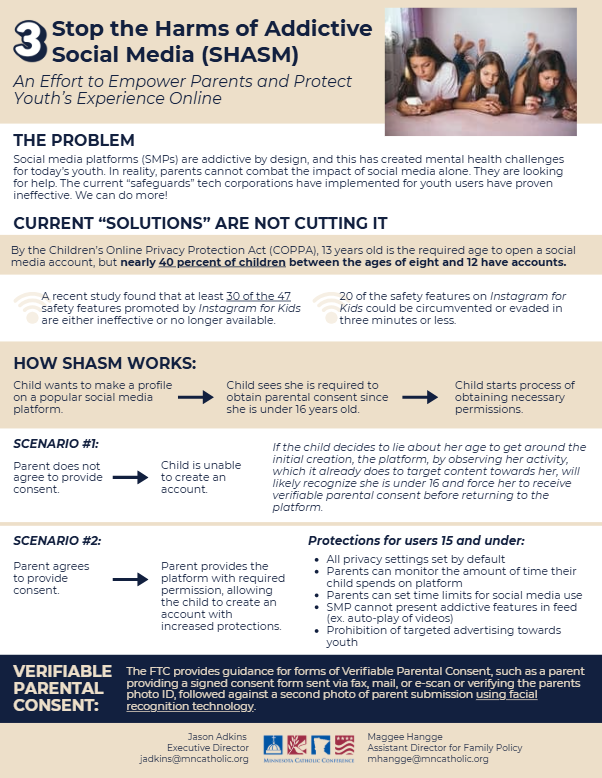
Stop the Harms of Addictive Social Media (SHASM) Act puts parents back in the driver's seat of their kids' social media usage.
SHASM would require that children under the age of 16 receive consent when creating a social media account. If the child tries to get around this, the platform will boot the user off until parental consent is given. Big Tech should not be allowed unlimited access to our children— SHASM puts parents back into the equation.
- If a child is granted permission to create a social media account, the user experience must be less addictive and exploitative. Some of the protections include:
- No targeted advertisements
- No auto-play videos
- No infinite scrolling
- No push notifications
- All privacy settings are set by default
- Parents will have the ability to monitor the amount of time their child spends on a platform
- Parents can set time limits for social media use
We would not let unknown people videotape our children at a park and then target them with ads. The same should be the case for social media. SHASM would help mitigate some of the most addictive features on these platforms while minimizing the commodification of children’s data from their online activity.
View our one-pager in PDF form

Protecting Kids from Social Media Addiction
A solution to minors spending too much time on social media without parental guidance is gaining traction at the Capitol. It’s called the...
Continue reading…