![[DEV] MN Catholic Conference](https://assets.nationbuilder.com/themes/65df773c6ffa600228371ffb/attachments/original/1709322834/logo.png?1709322834)
Verbal Testimony in Support of the Stop the Harms of Addictive Social Media Act, Maggee Hangge, Minnesota Catholic Conference
Chair Liebling, Chair Scott, and members of the committee:
My name is Maggee Hangge, and I am here from the Minnesota Catholic Conference, the public policy voice of the Catholic Church in Minnesota, to share our support for House File 4138, the stop the harms of addictive social media act. Please vote yes.
Social media platforms are designed to be addictive, and clearly their business model is working. Kids spend huge portions of their day online, and they are replacing in-person relationships with online interactions, which is leading to mental health challenges like anxiety and depression. According to a 2025 Pew Research Study, 48 percent of teens say that social media has a mostly negative effect on people their age, a 16 percent increase in just three years.[1] Additionally, studies link Instagram usage, especially in teen girls, to struggles with body image and self-worth. Instagram also has the highest percentage of adolescent users reporting cyberbullying.[2]
We should not sit back and let Big Tech harm the lives of our children. They deserve better.
This bill would help alleviate these problems through two key parts: 1) It would require verifiable parental consent for child accounts, and 2) it would require that social media platforms be less addictive by design for youth under 16.
Nowhere else do we allow minors to enter a contract—not for sports, camps, or school outings. Yet they are allowed to sign over their data to Big Tech, and sometimes without their parents even knowing. The kids, then, become the products off which the platforms can profit. As adults, we should not be content with this predatory business model. Parents deserve the right to consent to their child’s account creation.
But one could argue, shouldn’t parents just be better parents and limit the amount of time their kids spend online, if they feel the need? The reality is, not all parents are in a position to monitor their children as closely as they would like—they may work long hours or be a single parent just trying to keep up.
Ensuring that the platform is designed to be less addictive will help all children. If a parent provides consent, he or she can do so knowing that the most addictive features—targeted advertising, infinite scroll, auto-play video, and more—will be prohibited for child accounts. This puts all children on the same playing field while simultaneously stifling the addictive appeal.
Let’s not leave it to these platforms to self-regulate. Other countries and states are already taking steps to protect youth online. Minnesota should follow suit. Please support this bill to ensure a safer digital environment for our kids.
Maggee Hangge, [email protected]
[1] https://www.pewresearch.org/internet/2025/04/22/teens-social-media-and-mental-health/
[2] https://pmc.ncbi.nlm.nih.gov/articles/PMC11940074/#:~:text=This%20can%20damage%20one's%20body,reflections%20of%20how%20people%20look.

Action Alert: Urge legislators to protect all children!
Continue reading…
Protecting children from gun violence has multiple elements
After the tragic shooting at Annunciation Catholic Church and School in Minneapolis last year, it is understandable to have passion and r...
Continue reading…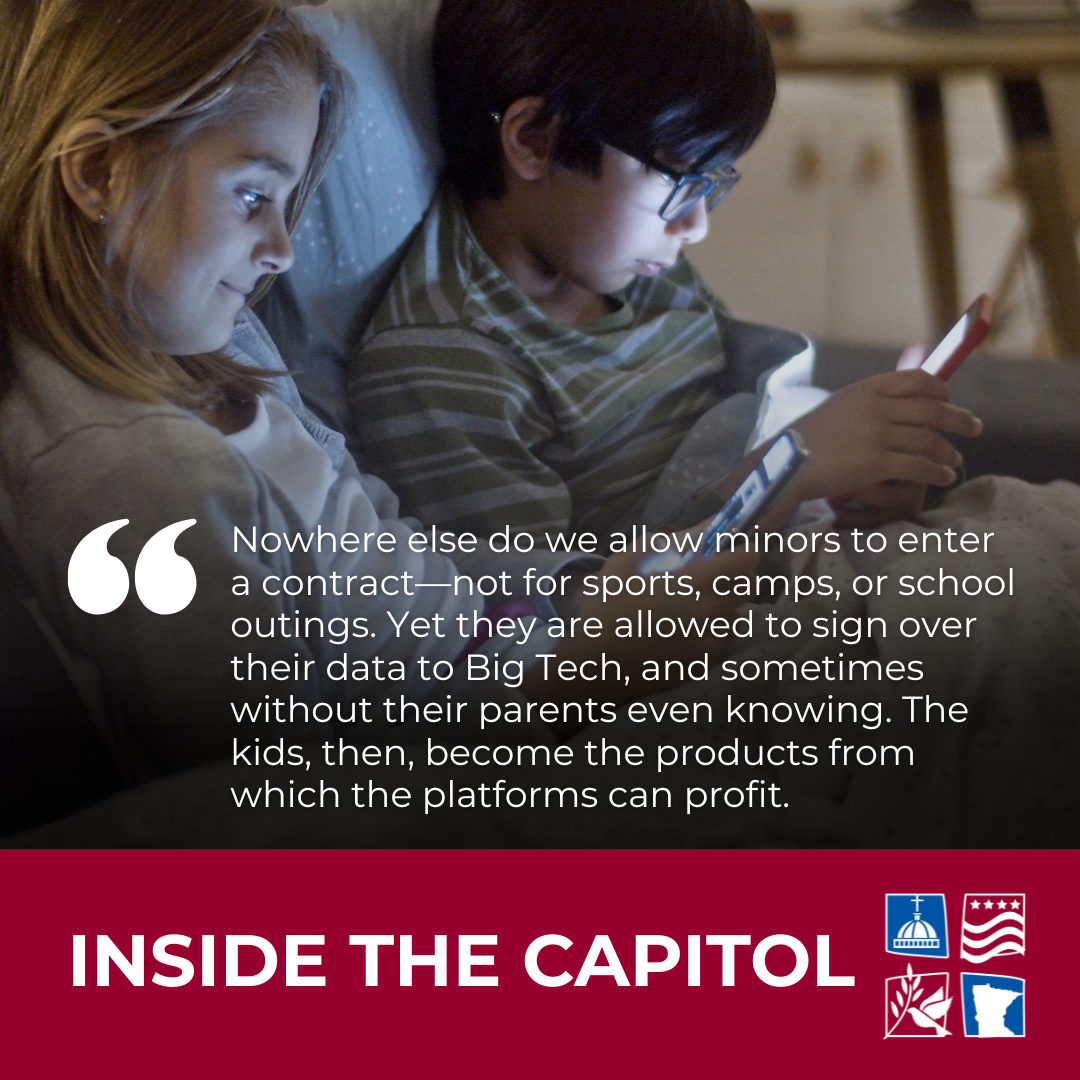
Protecting Kids from Social Media Addiction
A solution to minors spending too much time on social media without parental guidance is gaining traction at the Capitol. It’s called the...
Continue reading…
Protecting Kids from Social Media Addiction
A solution to minors spending too much time on social media without parental guidance is gaining traction at the Capitol. It’s called the...
Continue reading…