![[DEV] MN Catholic Conference](https://assets.nationbuilder.com/themes/65df773c6ffa600228371ffb/attachments/original/1709322834/logo.png?1709322834)
New Studies Reveal Why Minnesota Should Not Decriminalize Sports Gambling
This column was originally published in the Catholic Spirit on November 14, 2025.
A recent Pew Research Center poll shows that 47% of men under the age of 30 believe online sports betting has harmful effects on society, a sharp increase from 34% in 2022. This shift is telling. Young men are the primary drivers of online sports gambling and are seeing the consequences firsthand.
Over the past decade, we’ve learned that tech companies excel at capturing attention online, often through addictive algorithms that prioritize profit over well-being. Gambling platforms are no different. They thrive on targeting repeat bettors, even when it puts the poor and vulnerable at significant risk. But the more a person bets, the more they lose.
Online sports betting platforms are consumer-fraud schemes and should not be allowed to operate in our state. We need to continue to stand against their legalization.
A moral concern for the human person
Pope Leo XIV recently addressed the dangers of online sports gambling in a statement at the National Conference on Addictions. He warned that “the growing use of the internet, computers, and smartphones is associated not only with clear benefits, but also an excessive use that often leads to addictions with negative consequences for health such as compulsive gambling and betting, pornography, and an almost constant presence on digital platforms.”
The late Pope Francis also condemned sports betting, saying, “It makes me sad to see soccer games and sports stars promoting gambling platforms. That’s not gambling. It is an addiction. It’s putting your hand in the pocket of the people, especially the workers and the poor.”
Impact on individuals and families
Imagine a Minnesota where everyone carries a casino in their pocket. The temptation for a quick financial fix grows when unemployment rises, inflation squeezes families, and young people search for financial stability. It is during these vulnerable moments when gambling industries prey on individuals who are not in a financial state to wager bets in seconds. They promise instant wins but deliver lasting harm.
To prove this, new research shows that gambling companies earn more than half their profits from just 5% of their most addicted users. The ripple effects are real: increased poverty, family fragmentation, addiction, substance abuse, and even domestic violence are all symptoms. These harms would spread through our communities and would further implicate pastoral action when our priests are already experiencing high levels of burnout.
An unjust wealth transfer
Online sports gambling is not entertainment; it is an industry designed to extract wealth. One study revealed that fewer than 5% of online sports gamblers come out ahead. The math is simple: the more people gamble, the more companies profit. That is why platforms like FanDuel and Caesars lure users with offers like “$200 in bonus bets after your first $5 wager.” These incentives are not generosity; they are bait.
Proponents tout tax revenue as a benefit, but the numbers tell another story. At a 22% tax rate, projected revenue is about $80 million while industry profits approach $500 million. That means their total revenue is in the billions. Most of that money leaves Minnesota for out-of-state corporations. This is a massive, unproductive wealth transfer.
What can we do?
In 2025, the Minnesota Catholic Conference and its legislative allies stopped bills HF 1842 and SF757 from advancing. These bills would have legalized online sports betting in Minnesota. But we will likely see another push during the 2026 session. Contact your state legislators now and urge them to oppose any future attempts to legalize online sports gambling.
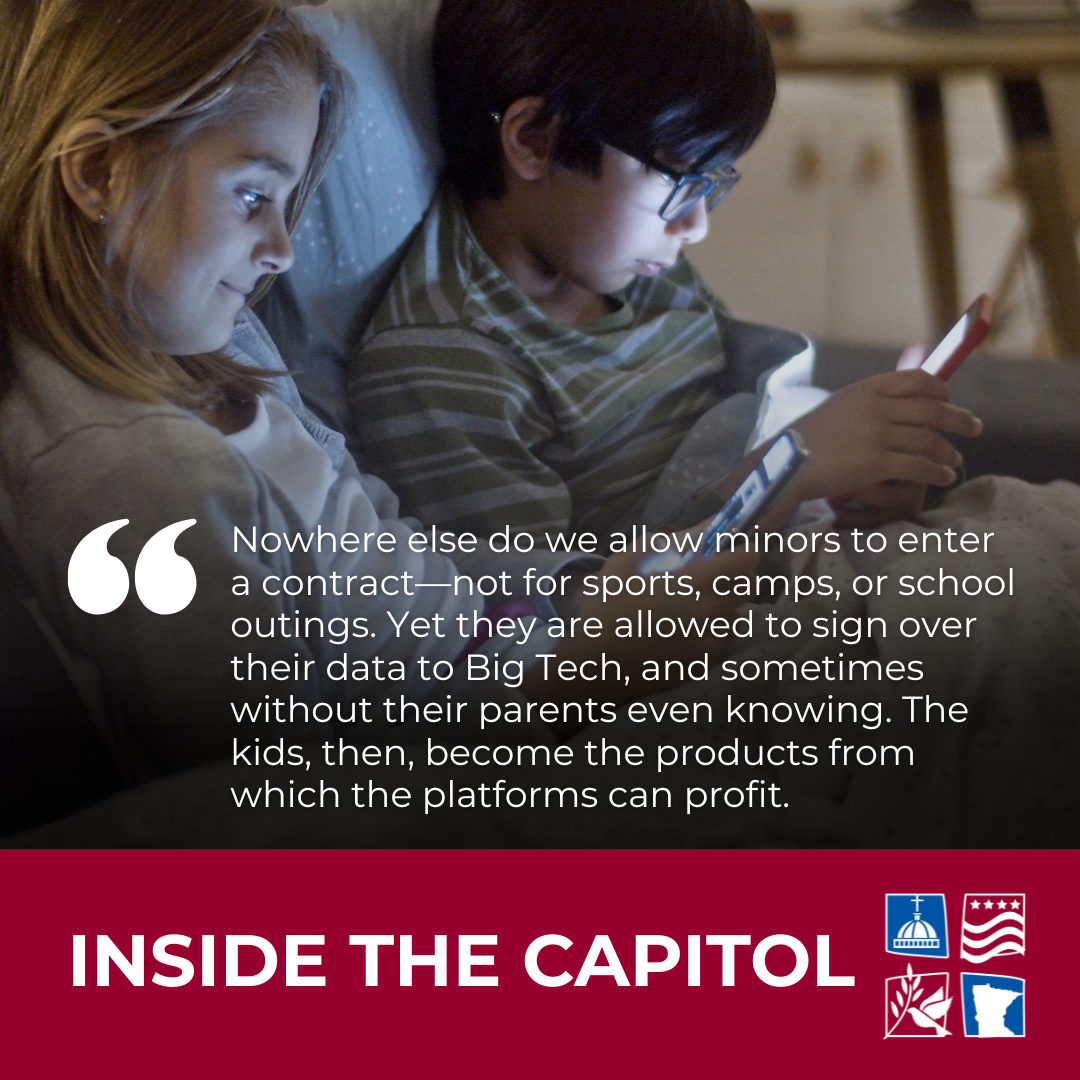
Protecting Kids from Social Media Addiction
A solution to minors spending too much time on social media without parental guidance is gaining traction at the Capitol. It’s called the...
Continue reading…
1,000+ Catholics advocate for life & dignity + immigrant driver's licenses, & school choice bill
In this episode, we feature Catholics at the Capitol, a day of prayer, inspiration, education, and advocacy, during which than 1,000 Catholics from across Minnesota came together to learn about faithful citizenship and how to be effective advocates for life and dignity.
Continue reading…
Inside the Capitol: Sit-down Interviews with Rep. Kelly Moller & Rep. Greg Boe
In this episode of Inside the Capitol, we sit down to speak with two freshmen Catholic legislators to get their take on everything from their favorite part of the job, to legislative priorities, and even advice for those of you considering a run for office.
Continue reading…
Letter in Support of S.F. 4474 Concerning Online Sweepstakes Casinos
Letter in Support of S.F. 4474 (Rasmusson) Concerning Online Sweepstakes Casinos Senate Floor April 30, 2026Dear Senator: The Minnesota C...
Continue reading…