![[DEV] MN Catholic Conference](https://assets.nationbuilder.com/themes/65df773c6ffa600228371ffb/attachments/original/1709322834/logo.png?1709322834)
The Catholic Spirit: Prayer, struggle continue in effort to end abortion in Minnesota
Maggee Hangge, assistant director for operations and family policy at the Minnesota Catholic Conference in St. Paul, sat down recently with The Catholic Spirit to discuss the status of pro-life initiatives in Minnesota, including efforts to end abortion. The conversation is edited for length and clarity.
Q) Maggee, thank you for agreeing to spend time with us during Respect Life Month. People concerned about the right to life in Minnesota are struggling with recent events when it comes to abortion. There was a glimmer of relief in June 2022 when the U.S. Supreme Court overturned its 1973 Roe v. Wade ruling that legalized abortion across the country. But that turned to some dismay when a court’s ruling in Doe v. Minnesota that same year ended the state’s two-parent notification law for minors seeking an abortion and a mandatory 24-hour waiting period between an initial consultation and an abortion. Can you share with us other changes in abortion law that have occurred in Minnesota since the high court overturned Roe v. Wade, including the 2023 Protect Reproductive Options Act, or PRO Act?
A) (As) you mentioned, 2023 — coming off the high of Roe v. Wade — was a hard (legislative) session from a pro-life perspective. Minnesota moved that year from being a pro-choice state to really being a pro-abortion state. Lawmakers passed the Protect Reproductive Options Act, which now guarantees a right to abortion. They repealed the Positive Alternatives Act, which gave money to pregnancy resource centers and other pro-family organizations. They significantly modified the Born Alive Infant Protection Act, which mandated care for infants who are born in a botched abortion.
On top of that, the Democrat-controlled Legislature tried to pass — but luckily this didn’t pass — the so-called Equal Rights Amendment, which would provide a constitutional right to abortion, assisted reproduction, transitioning your sex, among other things. Different versions passed the House and the Senate. Fortunately, that language didn’t match up, and it didn’t go to the ballot. But we know that they’re going to keep trying to get that passed.
Q) There are several protections for abortion in Minnesota, including a Minnesota State Supreme Court decision.
A) You’re referring, I think, to Doe v. Gomez. This is a 1995 court case that many argue constitutionalizes a right to abortion. That kind of binds us in a sense, with what we can do. But the Doe v. Minnesota decision really took away all the safeguards around abortion that we had been working for, for 50 years. If the procedure is going to be happening, we had at least tried to make sure that women are safe, that they know what they’re getting into and some of these things. Those things got struck down by the case or repealed at the legislative level, which is really hard to see.
Q) The Legislature will convene Feb. 17 for the second half of its 2025-2026 session. What might the Minnesota Catholic Conference be watching for at this point in legislation that would impact access to abortion in the state?
A) Our top three from the pro-life perspective are the Equal Rights Amendment, the IVF insurance mandate and physician-assisted suicide. All three of these directly involve the state sanctioned killing of human life, the state allowing us to kill innocent humans. That’s why we’re watching them so closely and activating Catholics on these issues.
Q) Reproductive technology in many of its forms can pose a threat to the call by the Catholic Church to respect life. Can you describe some of these threats and what Minnesotans can do to protect life? For example, in vitro fertilization in Minnesota.
A) There’s just so many ethical concerns. We have a lot of sympathy for couples who are facing infertility. I don’t wish that on anyone. But going down the path of using this technology is just not the answer. We’ve seen (attempts) to mandate health insurance coverage for IVF, and that’s really what we’ve been successfully stopping so far.
Q) What are some of the concerns?
A) It’s very expensive and it doesn’t have a very high success rate. Mandating coverage of IVF could raise premiums. When you look at it from the ethical perspective, more babies are killed, discarded, aborted through the IVF process than at Planned Parenthood. I think a lot of people don’t think about that side. We think about the life that comes from it. But there are so many other lives that are created that are discarded or potentially frozen. Now we’re seeing parents who have their tiny babies frozen trying to figure out what to do with that. And it’s expensive — $12,000 to $15,000 per cycle. Many families have to go through three cycles. Another problem is that it doesn’t solve the problem. Infertility is not a disease. It’s a symptom of something else. If you have something else going on and you get funneled into IVF, your chances of achieving pregnancy still may not be very high because you have another reproductive problem that’s happening that needs to get taken care of first.
Q) Surrogacy. What is that and what is the latest in Minnesota in this regard?
A) Like IVF, surrogacy poses a lot of risks in this assisted reproductive technology space. Paid surrogacy arrangements are akin to reproductive trafficking. Surrogacy provides an opportunity for anyone who has the money and means to buy a child to do so. And even at times to buy that gametic material that they need to make that child. We call them donors, but they are sellers. Basically, it creates a mix-and-match motherhood. You’re going to have someone who is carrying the child. You’re going to have someone who’s providing the material to create that child. That may be the intended parent, but it may not be. And then you’re going to have the intended parent. So, you potentially have three people involved in creating that child. And it’s expensive. The average surrogacy arrangement could cost anywhere from $45,000 to $80,000. Depending on other fees and costs these intending parents have to pay, they could be paying $100,000 to get a child. Isn’t having children good? Isn’t creating children good? I think this is what catches a lot of people. When you start to think of the commodification of children, when the child is grown in this mother’s womb for nine months and then stripped from that mother and sold for money to another parent. That poses a lot of risks for that child and creates dilemmas for them. We saw surrogacy pass in Minnesota in 2024 off the House floor. Fortunately, it didn’t make it through the Senate. But we expect to see that come up again. It’s something we’ve been vigilant about.
Q) There was a term presented to me that I wasn’t familiar with: restorative reproductive medicine.
A) Restorative reproductive medicine can be the answer for a lot of couples. Infertility is the symptom. It’s not the problem. There is a root problem. Endometriosis, hormone imbalances, things like this that cause women and men to struggle with their fertility. Why aren’t we trying to get to the bottom of that instead of funneling families and couples down these really expensive paths?
We have proposals and we’ve been talking with legislators. Can we encourage or mandate the Department of Health, for example, to include information about restorative reproductive medicine in some of their programing and some of the information that they’re giving out in this space? If we’re going to cover, for example, IVF, we should also be covering restorative reproductive medicine. Let’s give parents that option first, to figure out what’s going on before they get put down this path of assisted reproductive technology.
...
Q) Respect for life includes care for the elderly and infirm. What has happened in Minnesota in regard to physician-assisted suicide, and what proposals might lie ahead in 2026?
A) We address this issue in partnership with the Minnesota Alliance for Ethical Healthcare (ethicalcaremn.org). For the last 11 years, we’ve been able to stop physician-assisted suicide from becoming law in Minnesota. We hope that continues. We have a lot of advocates through our coalition, whether that be disability advocates, those concerned about racial disparities, health care advocates and people of faith. Many people have come together to say, let’s not support this. We remain vigilant and are asking Catholics to remain vigilant as well on this issue.
...
Read the full interview at The Catholic Spirit.

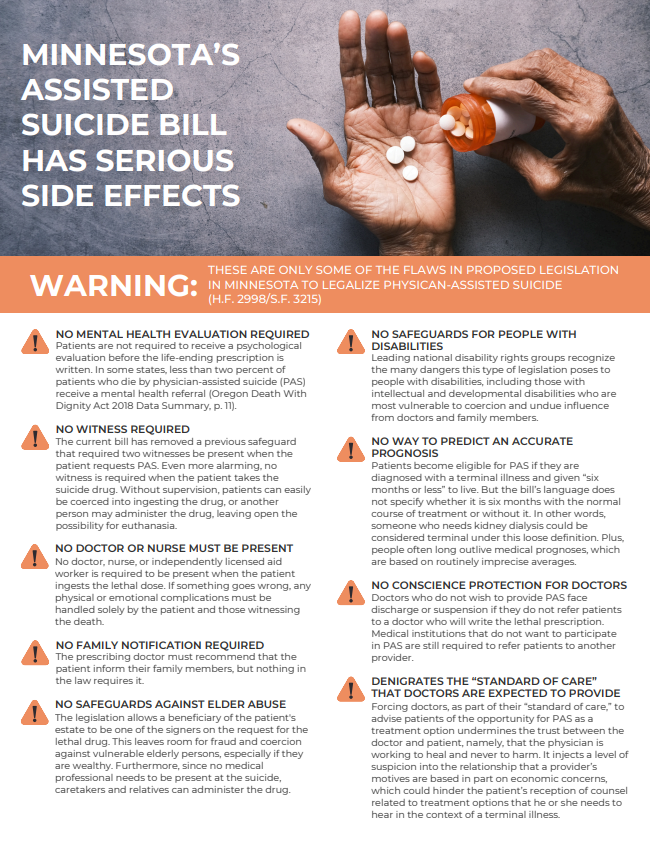

Our Sunday Visitor: Fighting the false ‘choice’ of physician assisted suicide in Minnesota
Our Sunday Visitor: Fighting the false ‘choice’ of physician assisted suicide in Minnesota
Continue reading…
Minnesota News Network: MN House Passes Surrogacy Bill, Family Council & Catholic Conference Oppose
Minnesota News Network: MN House Passes Surrogacy Bill, Family Council & Catholic Conference Oppose
Continue reading…
Alpha News: House Democrats approve surrogacy legislation, gun control bill
Alpha News: House Democrats approve surrogacy legislation, gun control bill
Continue reading…